

A Change In Scenarios

Friday, October 21, 2016
What To Do?
Short Term:
Because of the gap opening, no strong supply came into the market. Therefore, short-term positions to the upside should continue to be maintained. However, if strong supply comes in on Monday, short-term positions should be closed.
There are no short-term positions to the downside.
Intermediate & Long Term:
Because of the gap opening, no strong supply came into the market. Therefore, intermediate-term position to the upside taken on the spring should be maintained. However, if strong supply comes in on Monday, these new intermediate-term positions should be closed.
Older long-term positions to the upside should be maintained.
There are no intermediate or long term opportunities to the downside
Market Trends:
Intra-day: Neutral
Short Term: Neutral.
Intermediate Term: Neutral
Long Term: Neutral
The stock market, as measured by the Wyckoff Wave, traded lower on increased volume. It closed in the middle of a slightly narrower price spread, in a nearly oversold condition relative to the Technometer. The price spread and volume suggest the presence of demand.
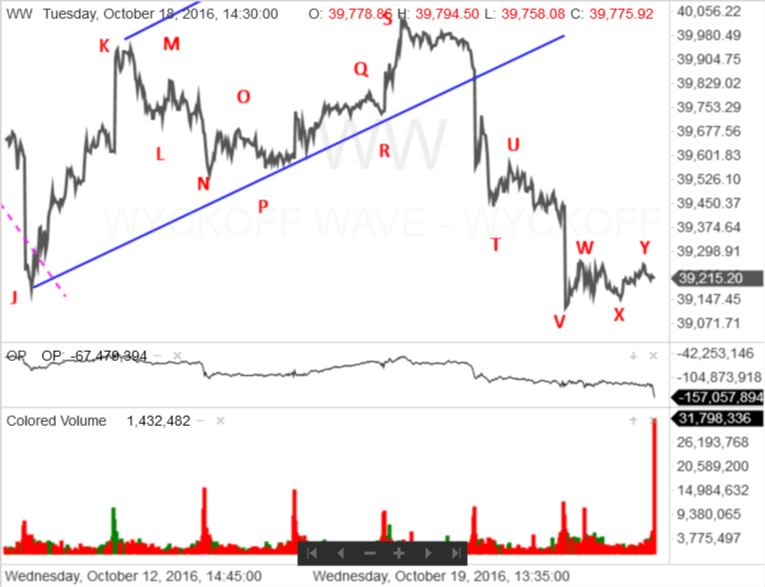
A review of the intra-day waves confirms the above. After a wide gap opening to the downside and a brief, five-minute, follow-through to point V, demand came into the market and the Wyckoff Wave rallied to point W.
After a brief reaction and rally, the Wyckoff Wave put in a relatively long, slow reaction, on reduced price spread and volume, to point X. The reaction was on a lack of supply.
Demand returned and the Wyckoff Wave rallied to point Y. Then, the Wyckoff Wave reacted for the last 50 minutes of the trading day. This reaction was on increasing volume and narrowing price spread. That suggests the presence of demand.
The gap opening was actually lower than today’s closing price. The gap opening took the Wyckoff Wave past the low at point J. However there was no follow-through to the downside. Instead, the Wyckoff Wave held above the low established in the first 5 minutes of the trading day.
The intra-day Optimism – Pessimism Index is in a positive divergence with the Wyckoff Wave when compared with point V. Once again, the effort to the downside is not being matched by the Wyckoff Wave’s price.
While the demand did come into the market, it was not particularly strong. There was no follow-through after the low at point J was penetrated. This suggests the Wyckoff Wave continues to have an opportunity to rally and test the highs at point S.
The Optimism – Pessimism Index reacted. It has returned to harmony with the Wyckoff Wave.
The Force Index continues to produce moderate, bordering on high, negative readings.
On Monday, the Technometer will open in a slightly oversold condition.
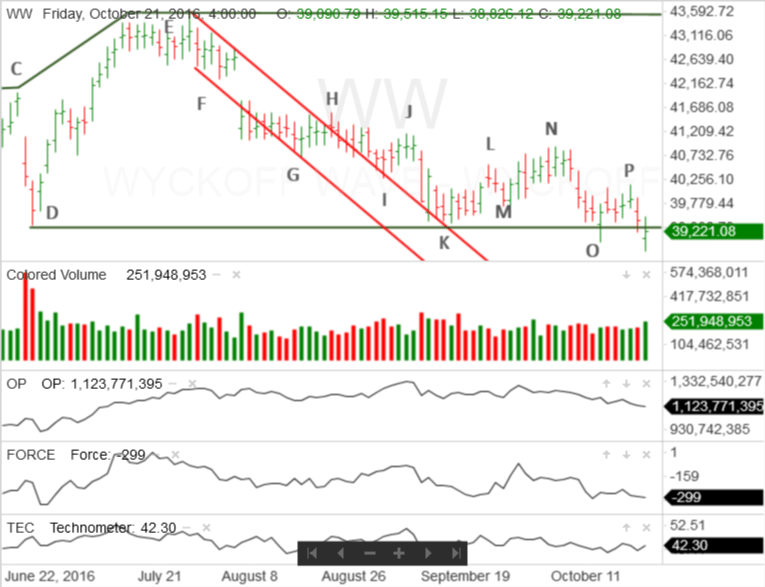
Today, before putting in a minor rally, the Wyckoff Wave reacted below the Spring at point O.
Unfortunately for the bulls, once again, while demand came into the market, it was not particularly strong or sustained. The good news was that little supply was present.
This suggests the Wyckoff Wave may be experiencing one of two new scenarios.
The first is a poor quality Secondary Test of the spring at point O. A poor quality Secondary Test occurs when the low price of the test is below the Spring’s low price. All poor quality Secondary Tests need to be retested and only then can the index or stock rally.
The second new scenario is that point O was not a Spring, but a new low in the trading range that began at point B and extended through point K. The support line would be adjusted to include point O and today’s market action.
If the Wyckoff Wave rallies on Monday, and moves past point P, and if demand is relatively strong, the Wave could be in a position to react and put in a successful Secondary Test.
If the Wyckoff Wave rallies, but demand is not particularly strong and there is little or no follow through to the upside, the Spring scenario can be eliminated.
The success of either one of these two scenarios rests on the quality of demand that comes into the market.
The lack of strong and sustained supply suggests the reaction back towards the bottom of the trading range scenario has little chance of success. This observation is supported by a nearly oversold Technometer that will become clearly, or even dangerously, oversold on any reaction.

Responses